How to enable HTTP Strict-Transport-Security (HSTS) on IIS
Set up HTTP Strict-Transport-Security (HSTS) response header in Windows Server IIS 10, here is some more technical information about HSTS in IIS, and other security headers...
Mastering Windows Server requires more than just following documentation; it’s about navigating the real-world complexities of deployment, security, and performance. From optimizing IIS for high-traffic environments and hardening OpenSSH configurations to managing PHP on Windows, this section provides deep-dive tutorials and battle-tested scripts. Whether you are managing legacy builds or the latest Windows Server 2025 releases, these guides focus on efficiency and stability for the modern infrastructure.
As environments shift toward hybrid setups, the integration between Windows Server and Linux-based tools has never been more critical. Here, you will find specialized knowledge on bridging that gap, including DevOps workflows, automation via PowerShell, and hardware-backed security. These articles are written by a sysadmin for sysadmins – cutting through the noise to deliver the specific configurations you need to keep your production environments running smoothly.
Set up HTTP Strict-Transport-Security (HSTS) response header in Windows Server IIS 10, here is some more technical information about HSTS in IIS, and other security headers...
Have you ever been in a situation where you needed to perform remote administration on a Windows Server, and the RDP port 3389 is blocked on a firewall? You can tunnel RDP over SSH with PuTTY
Schedule a PowerShell script to monitor local services in your Windows Server environment
To get and set File Server Resource Manager NTFS quota you now have to use PowerShell FileServerResourceManager cmdlets. It's pretty easy to get directory information with Get-FsrmQuota and change dirquota.exe using Set-FsrmQuota.
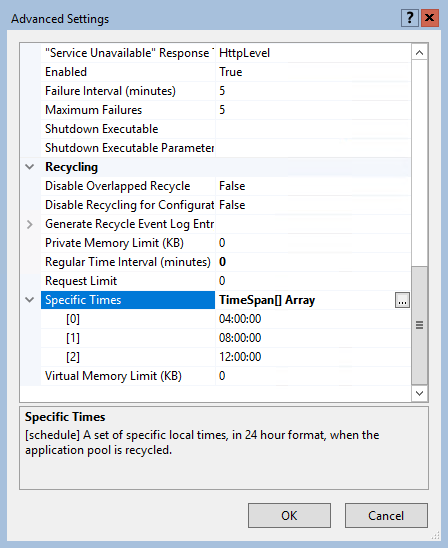
By default, an IIS application pool (or "AppPool") recycles on a regular time interval of 1740 minutes, or 29 hours. One reason for this time interval is that application pools don't recycle at the same moment every day (every day at 07.00 for example).
Here is how to install software packages during a Windows Deployment Services (WDS) deployment, without Microsoft Deployment Workbench (available in the Microsoft Deployment Toolkit, or MDT).
In this post you’ll learn about setting up a Monit monitoring service for your websites and services. Monit is a free and open source service monitoring application which can perform various event-based actions. Monit can send email notifications, restart a service or application, or take other responsive actions. We set Monit up on a Ubuntu 14.04 VM, built on Hyper-V. And we use Monit to monitor several websites, and send out notifications on downtime.
Over time, as your Windows Server runs longer, more and more disk space is eaten. Simply gone! Investigating the disk usage leaves you clueless; there are no large log files, crash dumps, or there is no software to be removed. Where did that space go?
ECN is an optional feature that may be used between two ECN-enabled endpoints when the underlying network infrastructure also supports it. Unfortunately, having one ECN Capability enabled endpoint may slow down outbound network connections to outdated network equipment.
The other day, when I attempted to add a newly installed Active Directory to become the slave domain controller of a master, the error message "A domain rename operation is already in progress" was displayed. Promoting the Windows Server 2012 R2 server to a Domain Controller failed.
In this article you'll learn how to start all stopped application pools that have the ApplicationPool.AutoStart property set to $True using AppCmd.exe or PowerShell. This is something you often or occasionally have to perform on various servers, for example when an application pool hangs.
Windows Server IIS loves to tell the world that a website runs on IIS. It does so with the "Server:" header in the HTTP response, as shown below. In this post I'll show you how to remove HTTP response headers in Windows Server IIS. You don't want to give hackers too much information about your servers, right?.
When the .svc web service handler doesn't work in IIS with ASP.NET 4.5 and returns a 404 Not Found error, you may need to add an extra handler to IIS. Read on...
Easily enable support for the WebSocket protocol on Windows Server IIS by installing the Web-WebSockets feature using PowerShell. Learn how to install WebSocket Protocol support in Windows Server IIS 8.0.
Sometimes it's important to remove (or hide) the file extension of scripts you use. Security by obscurity might be that reason, if you don't want others to know what script language you are using for your website, or for static site hosts.
Gzip compression conflicts with IIS Outbound Rules resulting in HTTP 500.52 URL Rewrite Module Error. Here is how to resolve this.
On IIS, Contact Form 7 captcha has one HUGE disadvantage: temporary captcha files placed in wp-content/uploads/wpcf7_captcha, are not automatically removed. Here is how to remove Contact Form 7 temporary captcha files on IIS…
Address both x86 and x64 versions of .NET with AppCmd. When administering an IIS web server you frequently have to use AppCmd.exe to make configuration changes. Whether it is for a specific web site or server wide. Some think AppCmd is very limited, but here is how you can target multiple ASP.NET versions with AppCmd!
The Forfiles command on Windows selects and executes a command on a file or set of files. Forfiles is ideal for batch processing through scripts, for instance on Windows Server systems. With Forfiles, you can run a command on or pass arguments to multiple files. For example, you could run the type or del command on all files in a tree with the .txt extension.
Use IIS Outbound Rules and URL Rewrite Module to create a custom created Content Delivery Network (CDN) for static content ofloading and speed-up your website.